Suckling Piglet: 7 Powerful Reasons It’s Spain’s Most Irresistible Roast
Few dishes in Spanish gastronomy command the same reverence as suckling piglet. Golden, blistered skin that shatters under the knife. Silky, delicate meat that barely needs chewing. A roasting tradition so precise it borders on ritual. Across Spain — and especially in the historic city of Segovia — suckling piglet is not simply food. It is heritage on a plate.
What Is Gambas al Ajillo?
But what exactly makes Spanish suckling piglet so exceptionally tender and crispy? The answer lies in a combination of breed selection, age, traditional wood-fired ovens, controlled moisture, and culinary restraint. In this guide, we break down the science, tradition, and technique behind Spain’s most iconic roast.
The Definition: What Is Spanish Suckling Piglet?
In Spain, suckling piglet is known as cochinillo asado. By definition, it refers to a pig that is:
- Between 2–3 weeks old
- Fed exclusively on its mother’s milk
- Weighing approximately 4–6 kg
- Extremely low in developed muscle fibers
Because the piglet has not consumed solid food, the meat remains extraordinarily pale, delicate, and naturally tender. This is the first key reason why Spanish suckling piglet achieves such a refined texture. Unlike mature pork, which requires marinades or slow braising to tenderize, suckling piglet relies on its youth for softness.
Why Age Is Everything
The tenderness of suckling piglet begins at the biological level.
1. Minimal Muscle Development
Young piglets have not developed dense muscle fibers. Less collagen means less connective tissue to break down during roasting. As a result:
- The meat stays moist
- The fibers remain soft
- There is no chewiness
2. Milk-Fed Fat Composition
Because the animal consumes only milk, the fat content is fine and evenly distributed. This delicate intramuscular fat melts gradually during roasting, naturally basting the meat from within. This is why authentic Spanish suckling piglet requires almost no seasoning — usually just salt and water.
The Role of the Wood-Fired Oven
In traditional Castilian asadores, suckling piglet is roasted in massive wood-fired ovens fueled by oak. These ovens provide:
- Consistent radiant heat
- Gentle convection
- Dry cooking environment
- High heat stability
The dry heat is critical. Moist environments soften the skin. Spanish roasting chambers maintain low humidity, which allows the skin of the suckling piglet to dehydrate slowly before crisping. In Segovia, centuries-old establishments still follow this technique with unwavering precision.
The Secret to Crispy Skin
Achieving that glass-like crackling on suckling piglet requires exact control.
Step 1: Skin Preparation
- The skin is left completely dry. No oil. No butter. Only salt. Moisture is the enemy of crispness.
Step 2: Slow Initial Roast
- The piglet is placed skin-side down first. This protects the surface and gently cooks the interior.
Step 3: Final High-Heat Finish
- It is then flipped skin-side up and exposed to stronger heat. The surface dehydrates and tightens, forming that iconic brittle crust.
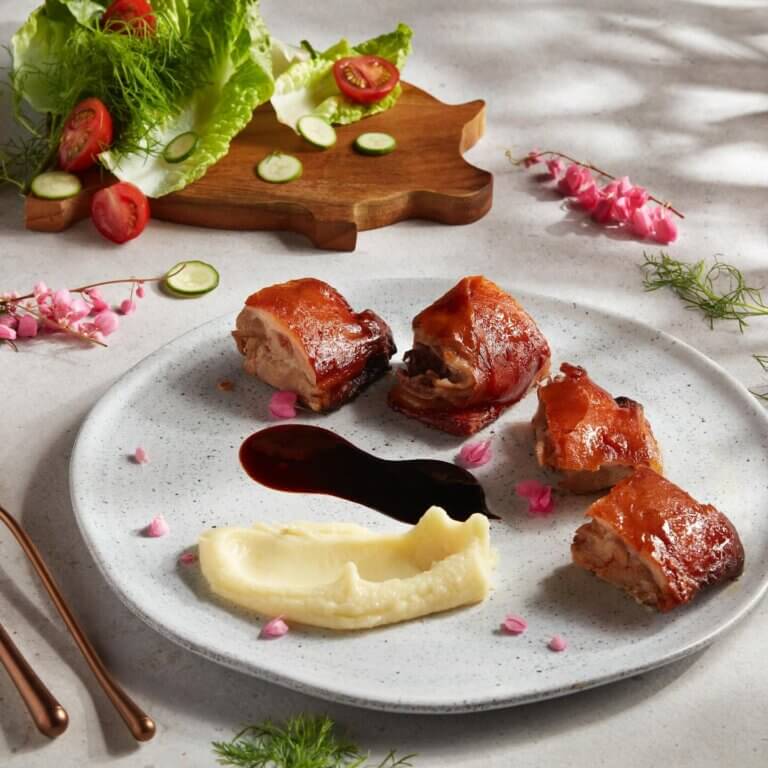
The result? A suckling piglet so crisp that, in some traditional restaurants, it can be cut with the edge of a plate.
Why It Differs from Other European Roast Pork
Many European roast pork dishes rely on marinades, spices, or long braising. Spanish suckling piglet stands apart because:
- It uses extremely young animals
- It prioritizes dry heat roasting
- It avoids heavy seasoning
- It focuses on texture purity
The emphasis is not on bold flavor layering but on ingredient excellence and technique precision.
Can You Recreate Spanish Suckling Piglet at Home?
While traditional wood-fired ovens are ideal, it is possible to prepare suckling piglet in a conventional oven by following core principles:
- Pat the skin completely dry
- Salt generously
- Roast at moderate temperature first (around 160°C)
- Finish at high heat (220–240°C) for crisping
- Avoid covering the piglet during roasting
The most critical element is patience. Rushing the process compromises both tenderness and crispness.
Final Thoughts: Why Suckling Piglet Remains Legendary
The perfection of Spanish suckling piglet lies in restraint, biology, and centuries-old roasting mastery. It is not a complicated dish. It is not heavily seasoned. It does not rely on sauces. Instead, it showcases:
- The purity of milk-fed meat
- The precision of wood-fired roasting
- The cultural pride of Castilian cuisine
- The art of texture balance
When prepared correctly, suckling piglet embodies everything refined about Spanish gastronomy — simplicity elevated through technique. If you truly want to understand Spain’s culinary soul, tasting authentic suckling piglet is not optional. It is essential.